
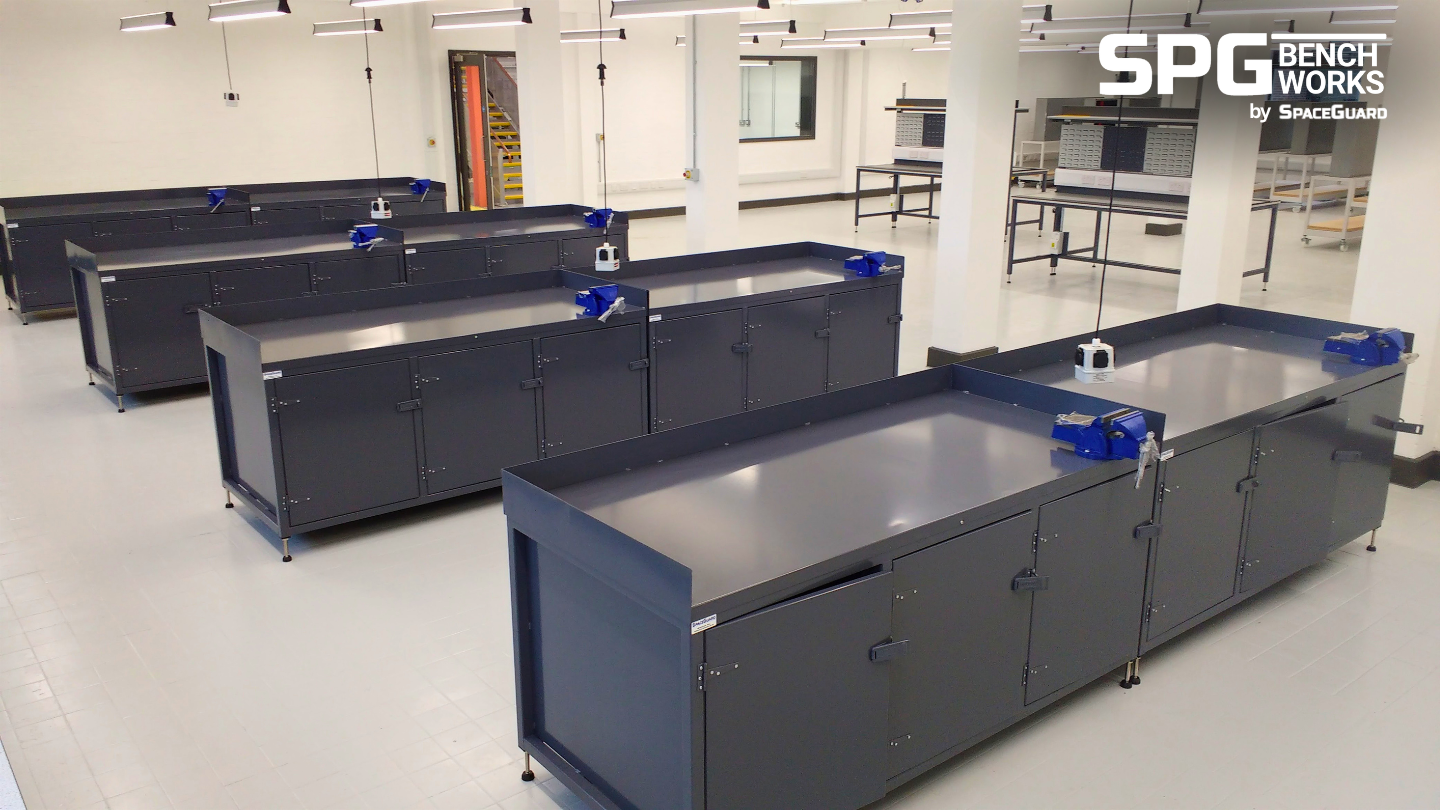
Heavy Duty Industrial Workbenches
A workbench that flexes under a gearbox, creeps across the floor when someone leans on a breaker bar or splits its top under a dropped casting is more than an annoyance. It slows the line and puts people at risk. Specifying heavy duty industrial workbenches properly means looking past the brochure photo to load ratings, frame sections, worktop materials and working heights. This guide sets out what engineers and production managers should check before ordering, so the benches on your shop floor suit the work done on them for years to come.
Quick answer: Specify heavy duty benches by their uniformly distributed load, typically 500kg to over 1,000kg. Look for welded or heavily braced steel box-section frames and a worktop suited to the task, such as solid beech, steel-clad or ESD laminate. Set the working height to the job and the equipment the bench will carry.
Key Takeaways
- "Heavy duty" has no fixed definition, so always ask for a stated uniformly distributed load and check how point loads are handled.
- Frame section size, wall thickness, bracing and joint type matter more to rigidity than the worktop alone.
- Choose the worktop for the task: solid beech for vice work, steel-clad for heavy engineering, stainless for hygiene, ESD laminate for electronics.
- Match bench height, depth and strength to the heaviest equipment and the most frequent task, not the average one.
- A durable bench with a replaceable top usually costs less over its working life than buying cheaper benches twice.
What Makes a Workbench Genuinely Heavy Duty?
No British Standard sets out what a "heavy duty" workbench must carry, so the label means different things to different manufacturers. One supplier's heavy duty bench is rated at 300kg; another reserves the term for frames that will take well over a tonne. The only reliable way to compare options is to ask for a stated load figure, find out how it was arrived at and check that it applies to the bench as configured, with its shelves, drawers and accessories fitted.
For context, the vast majority of bench failures we hear about across the industry are not dramatic collapses. They are slower problems: worktops that sag in the middle of a long span, frames that rack sideways when a fitter puts force through a vice, and feet that work loose on a vibrating slab. All of these come back to a bench that was rated for the load sitting on it, but not for the way that load was applied.
Distributed load versus point load
Most ratings are quoted as a uniformly distributed load (UDL): the total weight the worktop can carry when it is spread evenly across the surface. That is a sensible benchmark, but real loads are rarely so tidy. A 250kg test fixture standing on four small feet in the middle of a 2,400mm span is a point load, and it stresses the worktop and the frame rails far more than the same weight spread from end to end. Hammering, press work and dropping components add impact loads on top.
When you brief a manufacturer, describe the heaviest single item, its footprint, where it will sit and whether anything is struck, pressed or dropped on the bench. A good rule is to leave a healthy margin above your heaviest realistic load rather than specifying to the limit. If equipment will sit in one spot permanently, a supporting cross-rail or leg directly beneath it is worth far more than a thicker top.
Typical duty classes
As a rough guide to the UK market, light duty benches carry around 150kg to 250kg UDL and suit light assembly, packing and admin tasks. Medium duty benches typically sit between 300kg and 500kg. Heavy duty industrial benches usually start at around 500kg and run to 1,000kg, while extra heavy frames go beyond that for die setting, engine and gearbox work or press tooling. Remember that under-shelves carry their own, lower rating, so a fully loaded shelf full of spares counts against the frame too.
Frame Construction and Robust Materials
If the worktop is what you touch, the frame is what does the work. A frame that racks or twists will crack welds, loosen fixings and throw precision tasks out of true, however good the top above it. When comparing heavy duty industrial workbenches, look closely at the steel section, the joints and the bracing. Early in the process it helps to see how a range of industrial workbenches built in the UK is put together, because frame design varies more between suppliers than most buyers expect.
Steel section, wall thickness and joints
Lighter benches often use 25mm to 30mm tube or folded sheet legs. Heavy duty frames typically move up to 40mm to 60mm square box section with a wall thickness of 2mm to 3mm, which resists bending and denting from trolleys and pallet trucks. A perimeter frame directly under the worktop, plus a mid-height rail or under-shelf frame and rear bracing, stops the bench racking when force is applied from the front, as it is with a vice or a torque wrench.
Fully welded frames give the stiffest result and are the natural choice for the most demanding stations. Bolted frames can still be very strong if they use substantial brackets and high-tensile fixings, and they are easier to move through narrow doors or up to mezzanine floors. Benchworks delivers most of its benches fully assembled so they can go straight into use, with a self-assembly range for sites where access or on-site installation makes flat-packed delivery the better option. A powder-coated finish protects the steel against coolant, oil, cleaning chemicals and the knocks of everyday use far better than wet paint.
Feet, castors and floor fixing
Industrial floors are rarely flat. Adjustable levelling feet let you take out the undulations of a warehouse slab so the bench sits solid and the worktop stays level, which matters for measuring, assembly jigs and anything that might roll. Where a bench carries a vice, an arbor press or a bench-mounted machine, floor-fixing brackets stop it walking under repeated force.
Castors bring flexibility, but they change the sums. A mobile bench's capacity is limited by its castors as well as its frame, and the rating should assume that one castor might be carrying more than its share on an uneven floor. Specify industrial castors with total-lock brakes, and accept that a mobile bench will usually carry less than its static equivalent. If you are weighing up static and mobile options alongside other bench types, our complete workbench range shows how different frame styles compare.
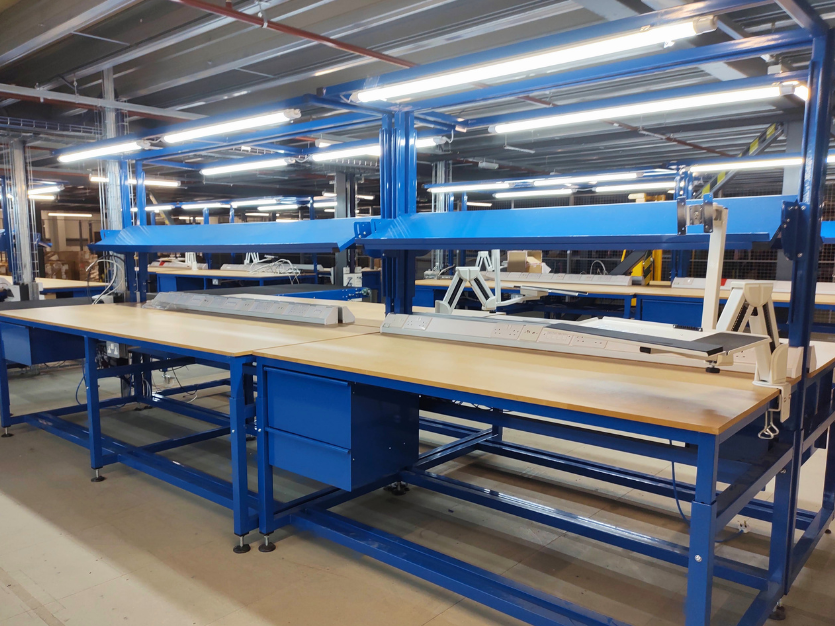
Choosing Worktops for Heavy Duty Industrial Workbenches
The worktop is the part of the bench that takes the punishment, and the right material depends entirely on what happens on it. A top that is perfect for fitting work can be a poor choice for electronics, and a hygienic stainless surface is wasted in a fabrication shop. The table below summarises the most common options and where each earns its keep.
Matching the top to the task
Thickness matters as much as material. A frame rated at a tonne is only as good as the surface spreading the load into it, and an 18mm board will dish under point loads long before the steel complains. For heavy duty industrial workbenches carrying concentrated weights, a 30mm to 40mm top or a steel-clad surface on a solid core keeps the load where it should be. Where tops will take repeated abuse, a replaceable sacrificial layer lets you refresh the surface without replacing the whole bench.
Specialist work brings its own requirements. Electronic workstations need an ESD surface that forms part of a controlled area under BS EN 61340-5-1, the standard most UK electronics manufacturers work to, with earth bonding points for wrist straps and mats. Laboratories need tops that will not stain or soften under the chemicals in use. Food and pharmaceutical lines usually need stainless steel throughout, frame included. Describe your processes in detail and a competent manufacturer will steer you towards a top that will last rather than one that simply looks the part on delivery day.
Matching Bench Strength and Size to Your Processes
A bench is part of a process, not a piece of furniture. The most common specification mistake is designing around the average job rather than the heaviest or most frequent one. Start with the tasks, the equipment and the people, and the dimensions and rating tend to follow naturally.
Working height, depth and ergonomics
Heavy work, where an operator leans in and applies force, is best done slightly below elbow height, often somewhere around 850mm to 900mm for an average adult. Precision work such as electronics or fine assembly is better nearer elbow height or slightly above, roughly 950mm to 1,050mm, so the operator is not hunched over. Depth is a balance too: 750mm to 900mm gives room for fixtures and parts bins without forcing a long reach to the back of the bench.
This is not just about comfort. The Health and Safety Executive's statistics for 2023/24 estimated 543,000 workers in Great Britain were suffering from a work-related musculoskeletal disorder, and the Workplace (Health, Safety and Welfare) Regulations 1992 require workstations to be suitable for the people using them and the work they do. Where different shifts or operators of varied height share a station, height adjustable bench options remove the compromise and reduce strain across the whole team.
Equipment, power and the production line
List everything that will be fixed to or stored on the bench. An engineer's vice can weigh 30kg to 60kg before anyone applies force through it, and it should be mounted over a leg or a reinforced corner, not mid-span. Arbor presses, bench grinders and test rigs bring weight, vibration and sometimes reaction forces that the frame must resist without movement. Then think upwards and downwards: shelving, drawers, task lighting and power integration are all options Benchworks builds in, and each one adds load and affects where the frame needs its strength.
On an assembly line, consistency matters as much as strength. Benches that share a common height and depth can be joined end to end so work passes smoothly from station to station, and the last bench on the line often hands over to dispatch, where purpose-built dedicated packing stations take over. Benchworks offers a free quotation or site visit, which is worth taking up when benches have to fit around existing machinery, columns, racking or walkways.
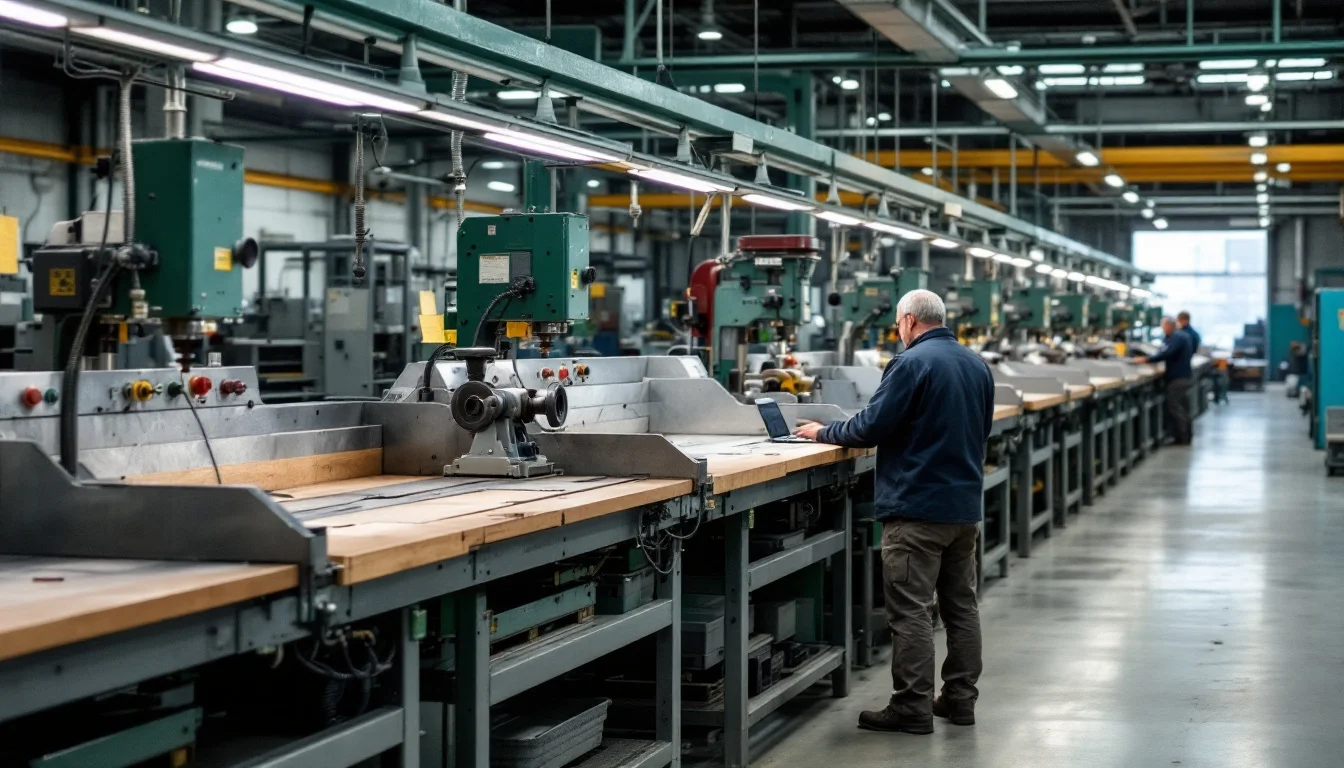
Why Durability Lowers Long-Term Cost
It is tempting to treat workbenches as a commodity and buy on price. On a busy production floor that tends to be a false economy, because a bench that fails early costs far more than its replacement price once you count downtime, disruption and the risk of injury.
Lifetime cost, not purchase price
As typical UK market figures, budget light-duty benches can be found for around £150 to £350, standard heavy duty benches commonly sit between £400 and £1,200, and made-to-measure heavy duty stations with specialist tops, power and accessories often run from around £900 to £3,000 or more. A bench at the top end that serves a production cell for fifteen years or longer works out far cheaper per year than a budget bench replaced every three or four, particularly if a worn top can be swapped rather than the whole unit scrapped.
There are hidden costs too. A bench that sags affects the accuracy of assembly jigs. A frame that racks loosens fixings and needs constant attention from maintenance. And a line stopped while a failed bench is cleared, replaced and re-equipped can cost more in an afternoon than the price difference between a cheap bench and a properly specified one. We share more practical advice on these trade-offs in our workbench guides and articles.
Safety, inspection and good practice
Where a bench carries or forms part of machinery, the Provision and Use of Work Equipment Regulations 1998 (PUWER) expect equipment to be suitable for its purpose and maintained in a safe condition. Even where that does not strictly apply, the same discipline makes sense. Label each bench with its rated load so nobody has to guess, and add a quick visual check to your planned maintenance routine: look for cracked welds, loose bolts, damaged castors, sagging worktops and feet that have backed off.
Robust construction makes those checks short and uneventful. A heavily braced, welded steel frame on levelled feet, carrying a top chosen for the task, simply gives fewer things to go wrong. Combine that with the Manual Handling Operations Regulations 1992, which encourage you to reduce lifting and awkward postures, and a well-specified bench becomes a genuine part of your safety system rather than an afterthought.
Frequently Asked Questions
How much weight can a heavy duty workbench hold?
Across the UK market, heavy duty benches are typically rated from around 500kg to 1,000kg uniformly distributed load, with extra heavy frames going beyond that. Always check whether the figure is a distributed or point load, and whether it applies with shelves and accessories fitted.
Is a welded frame stronger than a bolted one?
Welded frames are generally the stiffest and suit the most demanding work. Well-designed bolted frames with heavy brackets can still be very strong and are easier to move into awkward spaces, which is why self-assembly options remain popular for sites with restricted access.
Which worktop lasts longest in a heavy engineering workshop?
Steel-clad tops resist heat, oil and wear extremely well, while solid laminated beech handles impact and vice work and can be re-sanded. A replaceable hardboard-faced top is an economical choice where the surface takes regular abuse and can be swapped when worn.
What height should an industrial workbench be?
For heavy, force-based work, slightly below elbow height suits most operators, often around 850mm to 900mm. Precision tasks work better nearer elbow height or a little higher. Where several people share a station, a height adjustable bench is usually the best answer.
Can heavy duty benches be built to fit an existing production line?
Yes. Benchworks manufactures benches in its UK factory to suit specific spaces, processes and equipment, from a single one-off bench to production runs of 100 or more, and offers a free quotation or site visit to make sure everything fits.
Getting the specification right comes down to a few honest questions: what is the heaviest thing this bench will ever carry, how will force be applied to it, what surface does the task need and who will be working at it. Answer those carefully and you will end up with benches that stay rigid, level and safe for many years. If you would like help turning your requirements into a practical design, the team at Benchworks can talk through loads, frames and worktops with you and prepare a quotation for made-to-measure workbench designs built in the UK. Call 01482 426914 or request a free site visit to get started.